
Recalling Language - A Roguelike Item Identification System
Hello there!
Today I want to share my first design for an identification system and for magic scrolls in Tombs of Telleran. It aims to provide you as a player with enough information to prevent random guessing, while maintaining a sense of exploration and discovery. Let’s start with taking a look at traditional identification systems before digging in.
Identification Systems and Roguelikes
I know identification mini-games can be a divisive subject and a lot of digital ink has been spilled arguing over it. Personally I think decision making in uncertain situations makes for interesting gameplay, and an identification mini-game has potential to facilitate this. But you need some information to go on for it to be fun to use an unidentified item.
In older traditional roguelikes, this leads to people learning drop rates or item prices and use that information to inform their guesses. Or, when there is no available information, they stand next to a body of water in a hallway on an empty floor and quaff all potions. Or they play conservatively and wait for a magic item that identifies items for them. None of these are particularly satisfying systems to me. So how can we make identification more interesting than the usual experience of going from ‘I know literally nothing about this item’ to ‘I have already used the item’?
Recalling the Telleran Tongue
In Tombs of Telleran, item identification is motivated by you having spent ages dead in your coffin, so your memory is a bit spotty. In particular when it comes to letters and symbols. Identifying items means recalling more of your lost language.
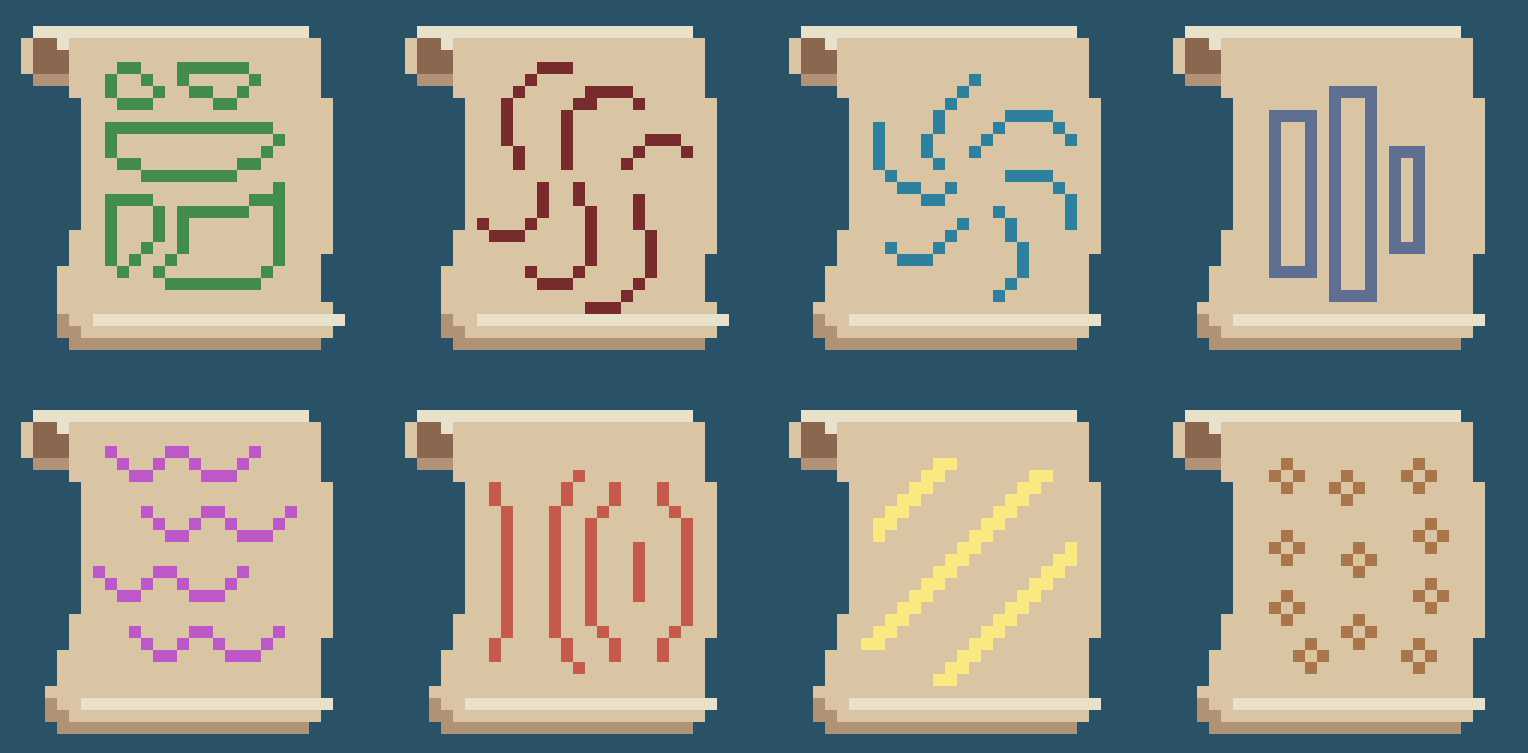
A few scroll sprites. The Telleran Tongue is a particularly colorful language.
This means that when you loot a scroll (which, as is tradition, provides a powerful one-time-use magical effect) from an ancient library, you will recognize some letters, but not all. Fortunately, this is enough to narrow the potential effects down to three (thanks Golden Krone Hotel for this idea!). These groups are generated randomly for each run. This lets you make informed guesses based on your current situation and the potential effects of your scrolls.
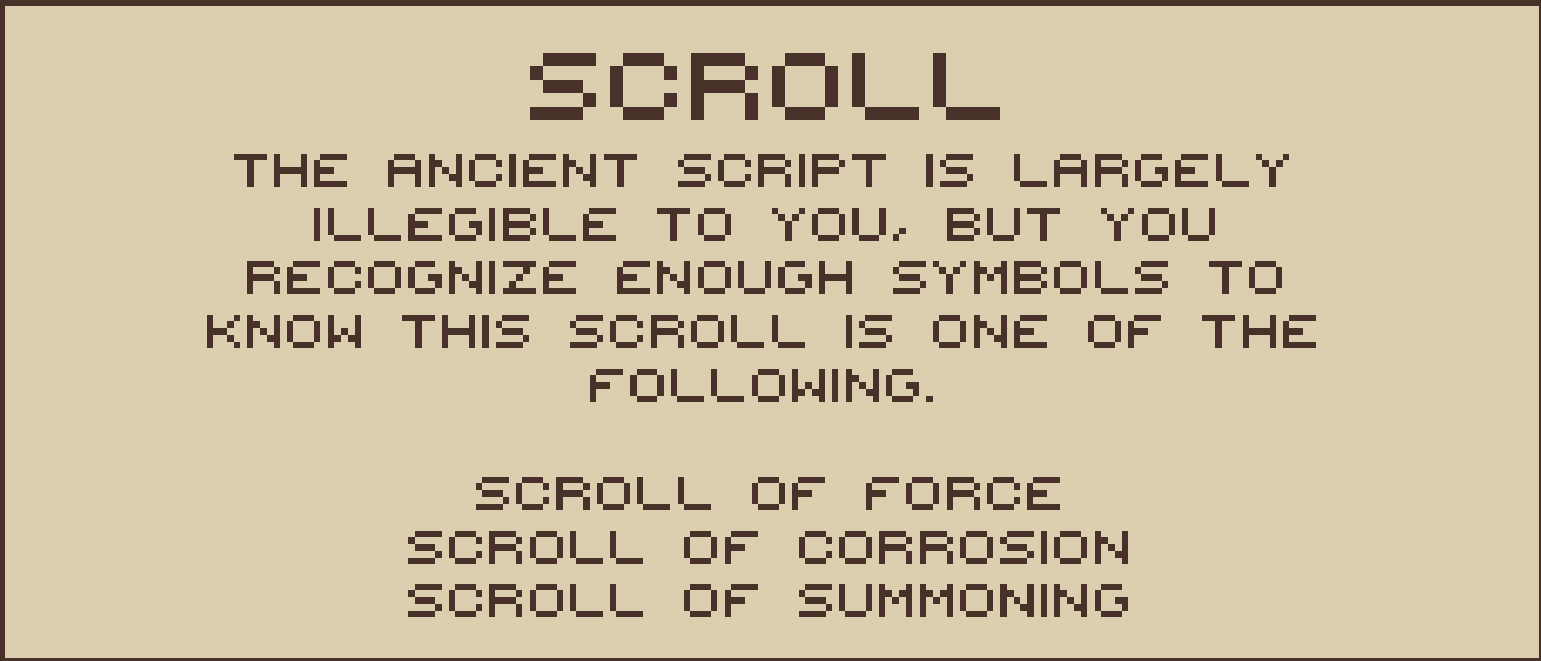
Description of an unidentified scroll. You know the scroll is one of three candidates.
Scrolls are identified in the classic way: by using them you learn their symbols and identify them for the rest of the run. But there are other ways to recover your language, and through that identify scrolls.
Uncovering Ancient Texts
As you explore the tombs you will be able to uncover ancient stone tablets with writing on them. These are consumable items that can be studied to recall new symbols, and identify a random unidentified scroll.

A few stone tablets sprites.
Through this mechanic, exploration becomes a method of item identification. Intact stone tablets are rare, and there will not be enough of them to identify all your scrolls, but they can be very helpful. Especially in the early game, when an identified scroll can be a matter of life and death.
Identifying a scroll early can also guide you as a player on what risks to take. If, for instance, you should identify a ‘Scroll of Corrosion’, you might feel more comfortable taking on armored skeleton guards, and can plan accordingly. By introducing a bit of randomness into the order scrolls are identified, they add diversity to your runs.
Wrapping Up
Together, scrolls and stone tablets make up the identification system in Tombs of Telleran. I’m very satisfied with the flavor, and think the “one-in-three scroll candidates” is a very nice way to give you just enough information to make meaningful decisions without resorting to tedious trial-and-error or metagame knowledge. I also like how the stone tablets introduce some variance in what order scrolls are identified in a natural way, and encourages exploration. Most importantly, this system eliminates frustrating guesswork while preserving the feeling of discovery and strategic depth.
That’s all for now! I hope you found this peek into Tombs of Telleran’s design interesting. If you want to stay updated on the game’s development and read more posts on roguelike design, feel free to join my mailing list - I’ll only send updates when there’s actually something worth sharing. You can also reach me on bluesky. Until next time!