Breathing Life into Tombs of Telleran's Resource Management Systems
At the heart of roguelikes lies interesting decision making and tactical gameplay. Every turn should present meaningful choices that impact both immediate survival and long-term success. In designing Tombs of Telleran, I want to create interlocking systems that generate these compelling decisions organically. Today, I want to share the initial resource systems players will master and their interactions, and reflect on their design philosophy.
The three core resources
Tombs of Telleran features three primary resources that players must carefully manage throughout their journey: health, corruption, and breath. While I’m sure some of these might sound familiar to veteran players, they interact in ways that I think adds a something more unique. Let’s examine each resource and how they work together to create interesting gameplay.
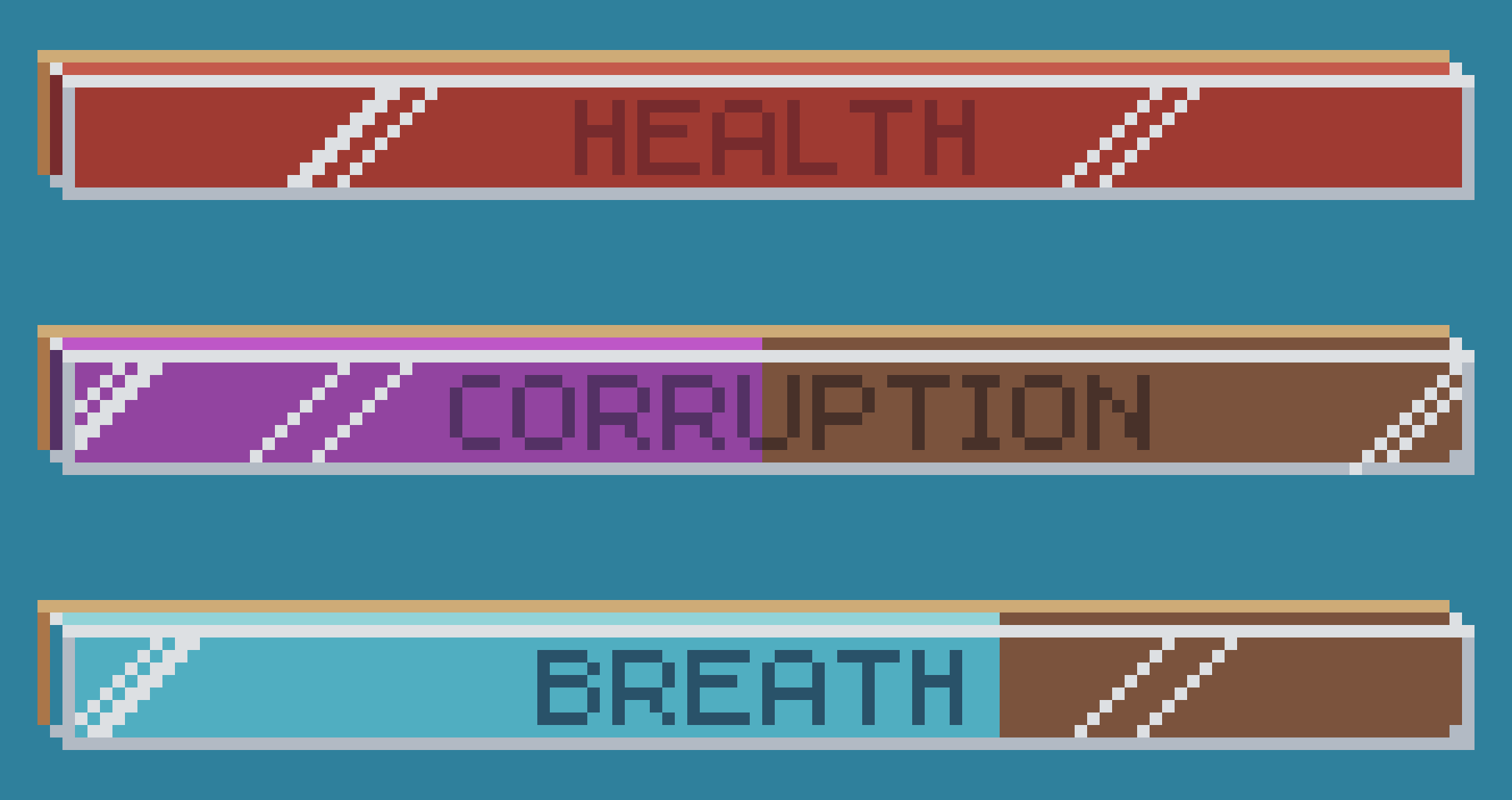
The (WIP) status bars of the three main resources.
Health: A Time-Tested Foundation
Health has been a staple in games for good reason. It is an incredibly convenient way of creating success/fail criteria without it being completely binary, while creating tension through visual feedback. Health doubles as a resource to manage and creates opportunities for tactical decision-making: Should you play it safe and use a health potion, or cast that powerful lightning bolt and weather the retaliation damage to maintain momentum?
Before settling on the classic health bar I explored a few alternatives. One compelling idea was to invert it, creating a “damage bar” that would fill up instead of depleting. This seemed particularly fitting for a skeletal protagonist, who isn’t traditionally “alive” in the first place. However, this would ultimately achieve the same mechanical result as a health bar while potentially diminishing the gameplay experience due to the psychology of loss aversion. Research has shown that “losing health points” creates more dramatic tension than “gaining damage points.” It would simply be different for the sake of being different, which isn’t the strongest argument. Sometimes, the conventional approach exists for good reasons.
Corruption: Risk and Reward
The corruption system brings something fresher to the table. As players explore the tombs and interact with their surroundings, they accumulate corruption through various means: wielding powerful equipment, casting potent spells, or opening cursed doors or containers to access shortcuts and valuable loot. As corruption accumulates, it manifests in two opposing ways: your actions become more difficult to perform (more on this in the section on breath!), but your damage potential grows stronger. This creates an interesting dynamic where you must balance both using your ‘corruption budget’ to solve problems short term vs ‘saving’ corruption for e.g. opening chests and shortcuts, and a diminishing action economy as your corruption increases, against increasing destructive power.
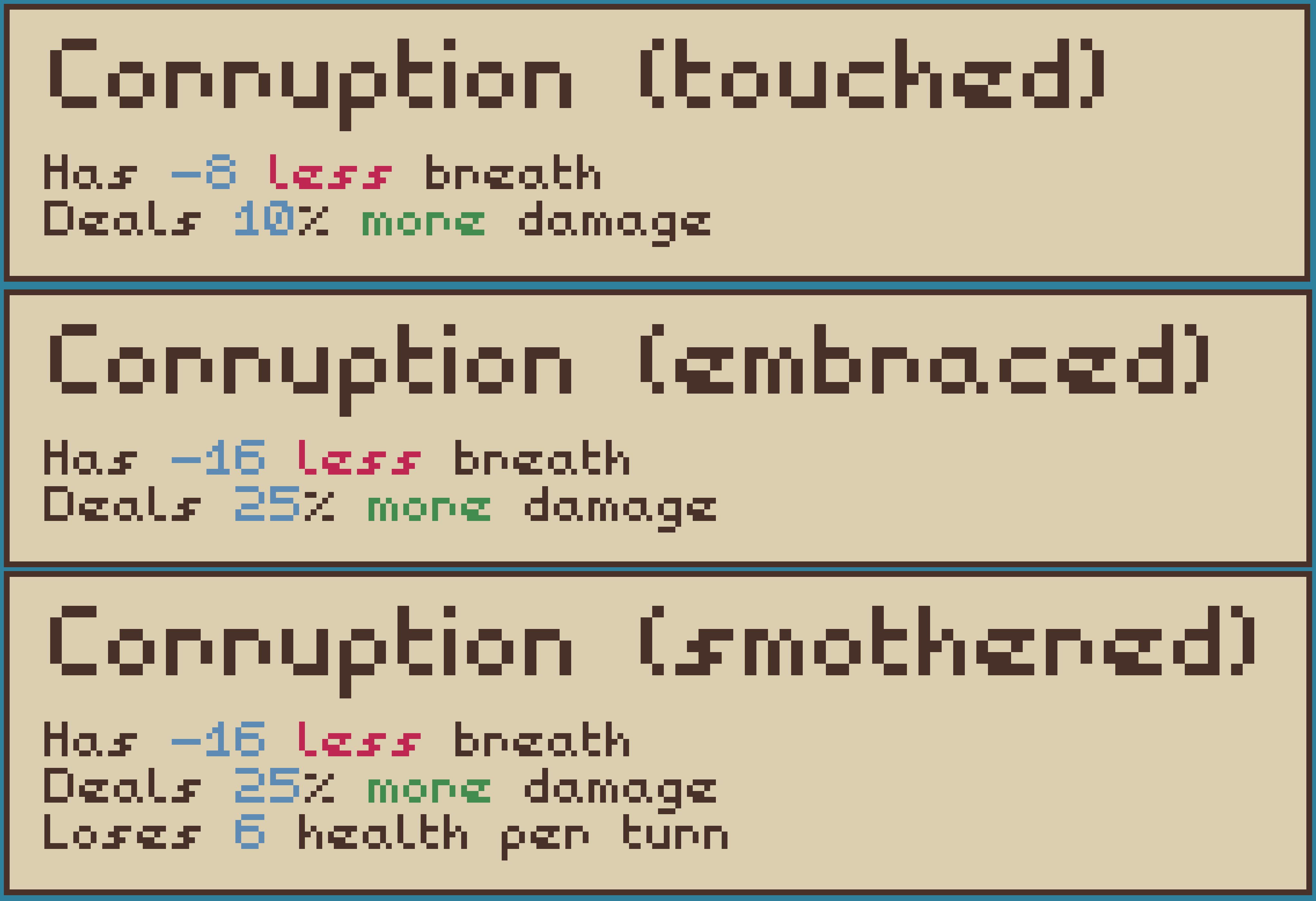
WIP Tool tips for the effects of increasingly severe corruption.
Of course you probably want to be able to reduce your corruption at some point. To that end you have access to various tools: Consumable items, shrines scattered throughout the tombs and wells between floors where you can wash away some corruption.. The corruption system is also deeply integrated with the final resource I’d like to show: the breath.
Breath: Spirit and Stamina
The breath resource draws inspiration from the Greek concept of pneuma – a word that translates to “breath” but carries deeper meaning in Stoic and religious contexts as “spirit.” In Tombs of Telleran, breath represents both the purity of your being and your capacity for action (think energy/mana/stamina). I’m very pleased with the dual interpretation and how it works mechanically/thematically: as corruption taints your spirit, it literally smothers your breath, limiting your tactical options. So as a player you want to be careful not to mindlessly swing that powerful cursed blade around, and perhaps think twice before you open a tainted chest.
The breath also interacts with combat in other ways: If an actor is out of breath they will not be as effective in combat, opening up for strategies that directly target the enemies breath to gain the upper hand. And if you are in a tough spot and need to escape, you might use the ‘Sprint’ ability which lets you take additional steps each turn. But sprinting takes a heavy toll on your breath, so make sure to plan your escape! You will not be in great shape for combat after a few turns of sprinting.

The 'puncture' ability directly damages the target's breath.
Finally, the breath resource encourages a bit of push-and-pull in combat and avoids ‘spam the best ability’-strategies, and does so more elegantly than adding ability cooldowns (which feel a bit arbitrary to me). Cooldowns might be required in the future for balance reasons, but I much prefer the breath system as it integrates so nicely thematically and mechanically.
Looking Ahead
Those are the core resources in Tombs of Telleran at the moment (well, ignoring inventory management)! The current implementation satisfies both mechanical and thematic goals: health provides clear feedback on your immediate danger, corruption adds long-term risk-reward decisions, and breath enables tactical depth while naturally limiting ability usage. Most importantly, these systems work together to create the kind of interesting decisions that make roguelikes engaging while maintaining thematic coherence. There is actually another resource we have yet to mention: time. Managing how long you spend exploring each floor will be important if you want to reach the lower levels. But that’s for another blog post!
While I’m satisfied with how these systems currently function, both mechanically and thematically, I’m eager to hear your perspectives. Have you encountered similar resource interactions in other games? What worked well, and what fell short? I’m particularly curious about your thoughts on the interplay between corruption and breath. Feel free to hit me up on bluesky if you’d like to talk!
And if you’d like to follow the continued development of Tombs of Telleran, consider joining my mailing list below. I’ll keep you updated with new blog posts exploring design decisions and development progress. Until next time!