
Tombs of Telleran Trinket Charge Pool
Hello everyone!
It’s spring here in Sweden and the weather is lovely. Hope you’re enjoying spring as much as I am! I have continued to develop the trinket system for Tombs of Telleran and have experimented with a few different systems. Today I’d like to share my thoughts on this resource-management design problem.
Trinkets and charges, you say?
Trinkets are items that you activate that do cool and useful things for you. You find them in the tomb and they are a major part of creating character builds. Here are a few example trinket descriptions.

Horned Idol trinket description.
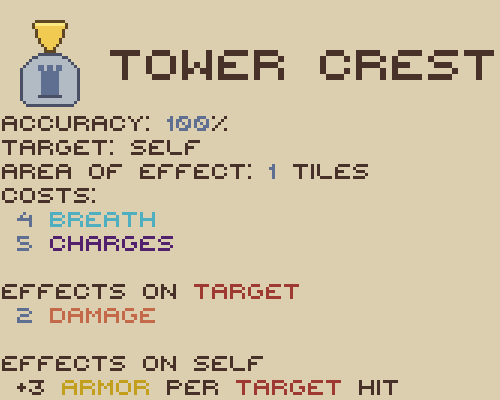
Tower Crest trinket description.
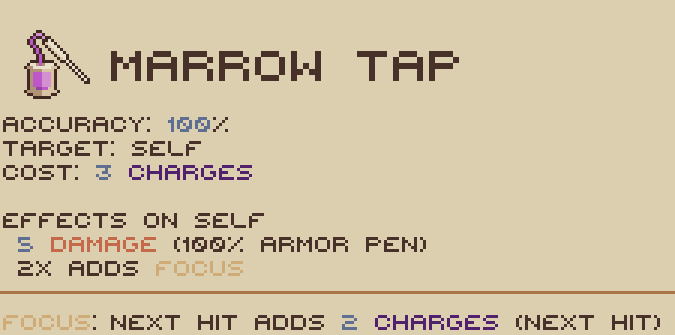
Marrow Tap trinket description.
As you can see in the descriptions above, the trinkets require charges to be used. This is a balancing lever to make sure a trinket can’t be used every turn, much like a cooldown system. Charges increase when corruption increases, and in the current version of the game they are held by the trinkets themselves. This means that one corruption increase -> one charge to one trinket. This has proven to be a bit restrictive. The trinkets charge slowly, and equipping more trinkets doesn’t feel great because you can’t charge them without losing out on using another trinket. This is the situation I set out to improve.
Alternative 1: Charge all the trinkets all the time
Instead of charging a single trinket when corruption increases, we could just charge all equipped trinkets. This solves the issue and makes all trinkets available for use. However, it creates a situation where you always want to keep as many trinkets equipped as possible (to not lose out on the charges), and sometimes you might want to hold consumables in your belt instead (which is then punished). It also introduces some resource-management balancing issues. In this system, the total number of charges you hold is increased at the same time as your available options (equipping a trinket increases both). I would prefer these parameters to be orthogonal and tweakable in isolation, which this prevents.
Alternative 2: Global charge pool
To decouple the total amount of resources that can be spent and the spending options, I introduced a charge pool. This is now very similar to a ‘mana’ system, but the recharge is decoupled from time and uses corruption instead. I think this is the best option, as finding new trinkets will always be exciting and open up new options while keeping a balancing lever.
Ending notes
It’s fun to be bold and naive and try to find new ways of tackling these types of resource-management systems. While trying to innovate, I keep rediscovering why industry-standard stuff like ‘mana’ exists. While it would be way more ’efficient’ to just copy popular systems straight away, it is much more interesting to take the scenic route through a bunch of not-so-great systems and understand why the popular systems are popular to begin with.
Thank you for reading, have a good one!